
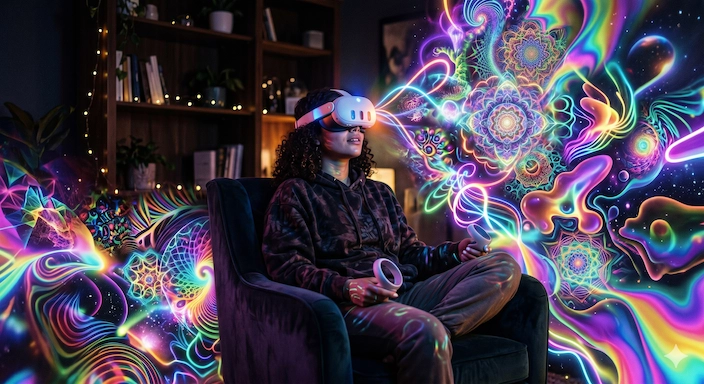
Psychedelic VR is emerging as a novel approach to inducing altered states of consciousness without the use of psychoactive substances. It represents a promising intersection between immersive technology and mental health, with potential applications in emotional regulation, wellbeing, and therapeutic intervention. In this post, we introduce the concept of Psychedelic VR and provide a review of the current scientific literature examining its clinical efficacy.
Recent advances in immersive technologies have generated increasing interest in the capacity of Virtual Reality (VR) to simulate core aspects of psychedelic experiences.
Although a consensus definition of Psychedelic VR has yet to be established, it can be conceptualized as an emerging class of immersive experiences designed to reproduce key features of classic psychedelic states (such as altered perception, awe, ego attenuation, connectedness, and mystical-type qualities) without the administration of psychoactive compounds (Matthews et al., 2025). Unlike conventional VR applications, which typically prioritise simulation, training, exposure, or entertainment, Psychedelic VR deliberately perturbs perceptual processing and the sense of self. Importantly, in contrast to pharmacological psychedelics, these experiences do not rely on receptor-mediated neurochemical mechanisms; classic serotonergic psychedelics primarily act via 5-HT2A receptor agonism, leading to large-scale alterations in cortical dynamics and functional connectivity. Psychedelic VR should therefore be understood as a non-pharmacological analogue of selected psychedelic processes rather than a direct pharmacological equivalent (Aday et al., 2020)
Emerging evidence suggests that VR-based psychedelic phenomenology (VRP) can reproduce both cognitive and neural correlates associated with classic serotonergic psychedelics. Experimental studies indicate that exposure to VR-simulated hallucinations may induce alterations in cognitive processing comparable to those observed under psychedelic substances, particularly in domains such as cognitive flexibility (Rastelli et al., 2022).
At the neurophysiological level, VR hallucination paradigms have been associated with changes in functional connectivity and increased neural entropy, patterns that closely resemble those reported during psychedelic states (Greco et al., 2021). Furthermore, recent findings suggest that VRP can replicate key neurophysiological and behavioral markers of psychedelic experiences in healthy individuals, supporting its potential both as an experimental model and as a therapeutic adjunct (Matthews et al., 2025).
Notably, immersive multi-user VR experiences, such as Isness, have demonstrated the capacity to elicit self-transcendent and mystical-type experiences comparable to those reported in controlled trials involving substances such as psilocybin or lysergic acid diethylamide (LSD) (Glowacki et al., 2020, 2022). These experiences are characterised by phenomena including ego attenuation, increased interconnectedness, and altered self-boundaries, which are considered central mechanisms underlying psychedelic-assisted therapeutic outcomes.
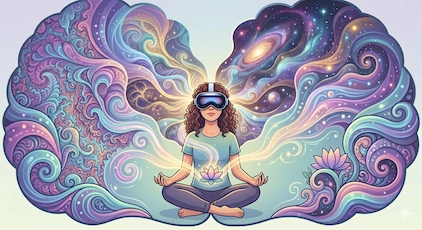
Beyond phenomenological similarity, VR-induced altered states appear to exert measurable effects on both emotional and physiological functioning. Hallucinatory Visual Virtual Experiences (hVVEs) have been associated with reductions in state anxiety and enhanced relaxation, accompanied by objective autonomic changes such as decreased heart rate and reduced sympathetic activation (Brizzi et al., 2025). These findings are consistent with a broader body of literature highlighting VR’s capacity to modulate affective states and facilitate relaxation (Sekula et al., 2022).
Preliminary clinical evidence further suggests that psychedelic-like VR interventions may hold therapeutic potential. For example, a feasibility study employing abstract, geometry-based VR environments reported significant reductions in depressive symptoms alongside moderate improvements in anxiety following a brief, therapist-supported intervention (Kaup et al., 2023). These outcomes are particularly relevant given the established role of psychological flexibility as a transdiagnostic mechanism in mental health, which has also been observed following VR-induced hallucinatory paradigms (Greco et al., 2025; Rastelli et al., 2022).
Importantly, VR-based psychedelic experiences may offer distinct advantages for populations in which traditional Psychedelic-Assisted Therapy (PAT) is inaccessible or contraindicated. In this context, an observational cohort study evaluating a multi-session VR intervention in individuals with life-threatening illnesses reported significant improvements in anxiety, depression, and overall wellbeing, alongside increases in perceived connectedness and spiritual wellbeing (Kettner et al., 2025). These findings suggest that VR may constitute a scalable, non-pharmacological alternative capable of reproducing some of the therapeutic benefits associated with psychedelic interventions.
In parallel, emerging VR applications integrating contemplative and affective components further illustrate the versatility of this approach. For instance, Ripple, a VR experience grounded in embodied compassion meditation, has been shown to enhance low-arousal positive affect (e.g., calmness and contentment), increase feelings of warmth and social connectedness, and elicit both mystical and peak experiences (Vidal et al., 2025). Similarly, commercially available platforms such as TRIPP have demonstrated the capacity to enhance positive affect, emotional engagement, and overall wellbeing in general populations (Chen et al., 2024; Fahey, 2025; Poetar et al., 2023), as well as to support perioperative wellbeing in clinical contexts (Schrempf et al., 2022).
Additionally, Maloka, a VR meditation application designed to facilitate mindfulness and relaxation through interactive and personalised experiences, has demonstrated efficacy in enhancing focus, engagement, and relaxation, as well as in improving attentional functioning and mindfulness-related processes (Gaetz et al., 2025). These effects are likely mediated by its multisensory design and the creation of immersive, personalised environments that promote sustained engagement with mindfulness practices.
Finally, a pilot study examining user experiences with Cosmic Flow, a psychedelic VR application based on kaleidoscopic meditation, reported preliminary evidence of enhanced self-reflection, increased affective engagement (including a desire for embodied movement within the virtual environment), and relaxation (Jung et al., 2022). Although exploratory in nature, these findings further support the potential of psychedelic-inspired VR environments to facilitate introspective and emotionally engaging experiences relevant to wellbeing outcomes.
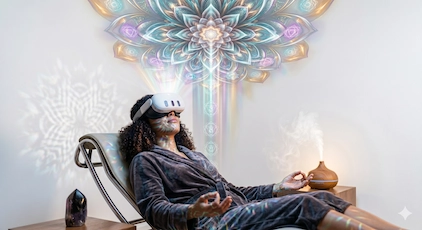
Although research investigating Psychedelic VR for substance use disorders remains at an early stage, recent theoretical and translational work suggests that virtual reality simulations of psychedelic phenomenology (VRP) may represent a promising adjunct to psychedelic-assisted therapy (PAT), particularly in the treatment of alcohol use disorder (AUD) (Matthews et al., 2025). This interest is motivated by the growing body of evidence supporting the efficacy of PAT for AUD, as well as by the practical challenges associated with its widespread implementation, including the need for highly specialised clinical teams, prolonged psychotherapy protocols, and extended monitored dosing sessions (Matthews et al., 2025).
Experimental research has demonstrated that VRP can reproduce several cognitive, neurophysiological, and phenomenological characteristics associated with classic serotonergic psychedelics. For example, VR-induced psychedelic experiences have been shown to increase cognitive flexibility (Rastelli et al., 2022), alter functional brain connectivity and neural entropy (Greco et al., 2021), reduce anxiety and physiological arousal (Brizzi et al., 2025), and promote feelings of connectedness and ego attenuation (Glowacki et al., 2022). These mechanisms are particularly relevant to addiction, given that psychological rigidity, impaired cognitive flexibility, maladaptive emotional regulation, and social disconnection are recognised contributors to substance use and relapse.
Rather than replacing psychedelic-assisted therapy, Matthews et al. (2025) propose that VRP may enhance different stages of the therapeutic process. Specifically, immersive psychedelic VR could be used to familiarise patients with altered states of consciousness before psychedelic administration, facilitate post-session integration by recreating meaningful aspects of the psychedelic experience, extend therapeutic benefits through booster sessions, and standardise the "set and setting" across treatment protocols.
Despite these promising perspectives, no clinical studies have yet evaluated Psychedelic VR as a stand-alone intervention for alcohol use disorder, nicotine dependence, or other substance use disorders (Matthews et al., 2025). Consequently, its potential role in addiction recovery remains hypothetical and requires validation through well-designed randomized controlled trials. Future research should determine whether Psychedelic VR can reduce craving, improve emotional regulation and psychological flexibility, enhance treatment adherence, and ultimately contribute to relapse prevention. If these benefits are confirmed, Psychedelic VR could represent a scalable, accessible, and non-pharmacological complement to existing addiction treatment approaches.
Taken together, current evidence supports the notion that VR can serve as a powerful tool for inducing altered states of consciousness that share key phenomenological, cognitive, and neurobiological features with psychedelic experiences. Although the evidence base remains preliminary and further controlled studies are required, VR-based psychedelic simulations represent a promising avenue for expanding access to transformative experiences, advancing experimental research, and developing novel, scalable interventions for mental health and wellbeing.
Aday, J. S., Davoli, C. C., & Bloesch, E. K. (2020). Psychedelics and virtual reality: parallels and applications. Therapeutic Advances in Psychopharmacology, 10, 2045125320948356. https://doi.org/10.1177/2045125320948356
Brizzi, G., Pupillo, C., Rastelli, C., Greco, A., Bernardelli, L., Di Natale, A. F., Pizzoli, S. F. M., Sajno, E., Frisone, F., Di Lernia, D., & Riva, G. (2025). Cyberdelics: Virtual reality hallucinations modulate cognitive-affective processes. Dialogues in clinical neuroscience, 27(1), 1–12. https://doi.org/10.1080/19585969.2025.2499459
Chen, Y., Wang, T., Tan, Y., & Li, D. (2024). Feasibility and effectiveness study of applying a hallucinogen harm reduction and integration model to a mindfulness thinking intervention using virtual reality: A randomized controlled trial. Digital health, 10, 20552076241249869. https://doi.org/10.1177/20552076241249869
Fahey, C. J. (2025). Virtual self care: Using virtual reality to support adolescent mental health and wellbeing. Telematics and Informatics Reports, 18, 100217. https://doi.org/10.1016/j.teler.2025.100217
Gaetz, C., MacDowell, P., & Fardadvand, S. (2025). Immersive mindfulness: Adolescents’ meditation experiences in Maloka VR. In Proceedings of the 11th International Conference of the Immersive Learning Research Network (iLRN 2025) (pp. 53–56). Immersive Learning Research Network. Available at: https://roam.macewan.ca/bitstreams/f8751b1d-0255-48d0-b0d9-1af5e3e107d0/download
Glowacki, D. R., Williams, R. R., Wonnacott, M. D., Maynard, O. M., Freire, R., Pike, J. E., & Chatziapostolou, M. (2022). Group VR experiences can produce ego attenuation and connectedness comparable to psychedelics. Scientific reports, 12(1), 8995. https://doi.org/10.1038/s41598-022-12637-z
Glowacki, D. R., Wonnacott, M. D., Freire, R., Glowacki, B. R., Gale, E. M., Pike, J. E., de Haan, T., Chatziapostolou, M., & Metatla, O. (2020). Isness: Using multi-person VR to design peak mystical-type experiences comparable to psychedelics (arXiv:2002.00940). arXiv. https://arxiv.org/abs/2002.00940
Greco, A., Gallitto, G., D'Alessandro, M., & Rastelli, C. (2021). Increased Entropic Brain Dynamics during DeepDream-Induced Altered Perceptual Phenomenology. Entropy (Basel, Switzerland), 23(7), 839. https://doi.org/10.3390/e23070839
Jung, S., Buruk, O. O., & Hamari, J. (2022). Psychedelic VR experience: An exploratory study on cosmic flow. In Proceedings of the 25th International Academic Mindtrek Conference (pp. 23–30). Association for Computing Machinery. Available at: https://cris.tuni.fi/ws/portalfiles/portal/76433808/Psychedelic_VR.pdf
Kaup, K. K., Vasser, M., Tulver, K., Munk, M., Pikamäe, J., & Aru, J. (2023). Psychedelic replications in virtual reality and their potential as a therapeutic instrument: an open-label feasibility study. Frontiers in psychiatry, 14, 1088896. https://doi.org/10.3389/fpsyt.2023.1088896
Kettner, H., Glowacki, D. R., Wall, J., Carhart-Harris, R. L., Roseman, L., & Hardy, J. L. (2025). Observational cohort study of a group-based VR program to improve mental health and wellbeing in people with life-threatening illnesses. Frontiers in Virtual Reality, 5, Article 1466362. https://doi.org/10.3389/frvir.2024.1466362
Matthews, S., Greco, A., Rastelli, C., & Bassir Nia, A. (2025). Virtual reality and psychedelics: new perspectives and new possibilities in the treatment of alcohol use disorder. Frontiers in psychiatry, 16, 1448043. https://doi.org/10.3389/fpsyt.2025.1448043
Poetar, C. R., Bradley, N., & Voinescu, A. (2023). Immersive virtual reality or computerised mindfulness meditation for improving mood? Preliminary efficacy from a pilot randomised trial. Frontiers in psychology, 14, 1157469. https://doi.org/10.3389/fpsyg.2023.1157469
Rastelli, C., Greco, A., Kenett, Y. N., Finocchiaro, C., & De Pisapia, N. (2022). Simulated visual hallucinations in virtual reality enhance cognitive flexibility. Scientific reports, 12(1), 4027. https://doi.org/10.1038/s41598-022-08047-w
Schrempf, M. C., Petzold, J., Petersen, M. A., et al. (2022). A randomised pilot trial of virtual reality-based relaxation for enhancement of perioperative well-being, mood and quality of life. Scientific Reports, 12, 12067. https://doi.org/10.1038/s41598-022-16270-8
Sekula, A. D., Downey, L., & Puspanathan, P. (2022). Virtual Reality as a Moderator of Psychedelic-Assisted Psychotherapy. Frontiers in psychology, 13, 813746. https://doi.org/10.3389/fpsyg.2022.813746
Vidal, J., Andreu, C. I., Wrzesien, M., Colombo, D., Wall, J., Glowacki, D. R., Hardy, J. L., & Cebolla, A. (2026). Inducing selflessness through a numadelic virtual reality experience: A preliminary study. Virtual Reality, 30, Article 30. https://doi.org/10.1007/s10055-025-01293-z