


Never before have digital technologies been so deeply integrated into everyday life. They have transformed how people communicate, learn, work, access healthcare, build relationships, and participate in society (Alsina-Jurnet & Guardia-Ortiz, 2015). Smartphones, in particular, have become constant companions that extend our cognitive, social, and emotional lives. This digital transformation has created unprecedented opportunities, including immediate access to information, enhanced social connectedness, personalized healthcare, and new educational and professional possibilities. At the same time, however, it has introduced new challenges associated with continuous connectivity, information overload, attentional fragmentation, blurred work-life boundaries, and increasing demands on emotional self-regulation (Wrede et al., 2023).
Against this backdrop, the concept of digital wellbeing has emerged as a framework for understanding what constitutes a healthy relationship with digital technologies (Vanden Abeele, 2021). Rather than referring to the absence of technology or simply reducing screen time, digital wellbeing is increasingly conceptualized as a dynamic and multidimensional state in which individuals engage with digital technologies intentionally, consciously, and adaptively, allowing technology to support psychological health, meaningful relationships, personal goals, and overall quality of life while minimizing unnecessary stress, distraction, and functional interference (Liberacka-Dwojak et al., 2026).
This perspective represents a fundamental shift in how technology is understood. Instead of asking whether digital technologies are inherently beneficial or harmful, digital wellbeing recognizes that their impact depends largely on how, why, and under which circumstances they are used. Consequently, the quality of digital engagement becomes more important than its quantity. Simply reducing screen time does not necessarily improve wellbeing if technology continues to be used reactively or without purpose, just as intensive digital engagement is not inherently detrimental when it remains intentional, goal-directed, and aligned with personal values (Liberacka-Dwojak et al., 2026; McCoy & Marcus-Quinn, 2025).
Ultimately, digital wellbeing is not about disconnecting from technology but about preventing technology from disconnecting us from ourselves, from others, and from what truly matters.
Although digital wellbeing encompasses every interaction with digital technologies, smartphones deserve particular attention because they have become the primary gateway to our digital lives. Unlike other digital devices, they remain within reach almost continuously, integrating communication, work, entertainment, education, social networking, navigation, banking, shopping, and healthcare into a single device that accompanies us throughout the day (Busch & McCarthy, 2021).
However, the characteristics that make smartphones extraordinarily valuable also make them uniquely capable of disrupting digital wellbeing. Modern smartphone ecosystems are designed to maximize user engagement through personalized notifications, infinite scrolling, algorithmically curated content, variable reward schedules, and frictionless transitions between applications (Montag et al., 2019; Roffarello & De Russis, 2023). These persuasive design strategies continuously compete for our attention, making digital engagement increasingly effortless while making disengagement progressively more difficult.
As a result, smartphone use can gradually shift from a conscious, goal-directed behavior to an automatic habit triggered by boredom, stress, loneliness, or the simple anticipation of a notification. Over time, individuals may experience reduced attentional control, diminished agency over their own technology use, and increasing difficulty disconnecting from digital environments. When this occurs, smartphones no longer simply support daily activities. They begin to compete with face-to-face relationships, work, study, sleep, and other experiences that are essential for wellbeing (Liberacka-Dwojak et al., 2026; Vanden Abeele, 2021).
Importantly, this does not mean that smartphones are inherently harmful. They remain powerful tools for communication, learning, healthcare, and social participation. The challenge is therefore not to use smartphones less, but to ensure that we use them intentionally rather than automatically. Understanding when this balance begins to deteriorate is essential for preserving digital wellbeing and provides the foundation for understanding problematic smartphone use.

The expression “smartphone addiction” has become increasingly common in both scientific publications and the media. However, despite its popularity, the term remains controversial. A central question continues to divide researchers: Are people addicted to smartphones themselves, or are smartphones simply the medium through which other potentially addictive online activities (such as social networking, gaming, online gambling, pornography, or video streaming) are accessed? (Panova & Carbonell, 2018; Montag et al., 2021).
For this reason, many researchers now prefer the terms Problematic Smartphone Use (PSU) or problematic mobile phone use, which emphasize the dysfunctional pattern of use without assuming that the smartphone itself constitutes the addictive object (Busch & McCarthy, 2021; Elhai et al., 2017). This perspective recognizes that smartphones are multifunctional devices capable of delivering countless rewarding digital experiences, each driven by different psychological mechanisms and motivations.
Importantly, smartphone addiction is not currently recognized as an official mental disorder in either the Diagnostic and Statistical Manual of Mental Disorders (DSM-5-TR; American Psychiatric Association, 2022) or the International Classification of Diseases (ICD-11; World Health Organization, 2022). This omission reflects the current lack of consensus regarding its conceptualization, diagnostic boundaries, and underlying mechanisms rather than evidence that problematic smartphone use does not exist.
Indeed, an expanding body of research demonstrates that, for a minority of individuals, smartphone use may become sufficiently excessive, persistent, and difficult to control to interfere with everyday functioning. Problematic smartphone use has been associated with impaired attentional control, poorer academic and occupational performance, sleep disturbances, emotional dysregulation, anxiety, depressive symptoms, reduced quality of life, and interpersonal difficulties (Busch & McCarthy, 2021; Elhai et al., 2017; Paterna et al., 2024).
The consequences of problematic smartphone use are not exclusively psychological. Research has also associated prolonged or poorly regulated smartphone use with musculoskeletal discomfort (particularly neck and back pain), lower levels of physical activity, digital eye strain, and poorer sleep quality (Al-Marri et al., 2021; Al-Amri et al., 2023; Eitivipart et al., 2018; Yang et al., 2020). Importantly, these associations appear to reflect primarily how smartphones are used (including prolonged screen exposure, sustained postures, sedentary behaviour, and nighttime use) rather than simply carrying a smartphone or keeping it close to the body. Although smartphones emit radiofrequency electromagnetic fields, current systematic reviews of human evidence have not established that exposure from mobile-phone use increases the risk of brain or other head tumours (Karipidis et al., 2024).
Taken together, these findings reinforce an important point: the defining characteristic of problematic smartphone use is not how many hours people spend using their smartphones, but the extent to which smartphone use becomes compulsive, difficult to regulate, and continues despite producing negative consequences.
Consequently, the debate has gradually shifted away from asking whether smartphones are “addictive” toward a more clinically meaningful question: When does smartphone use stop serving our goals and begin to control our behaviour? Answering this question is fundamental to understanding the psychological consequences of problematic smartphone use and to developing effective strategies for preserving digital wellbeing.
As research on problematic smartphone use has expanded over the last decade, numerous psychometrically validated instruments have been developed to assess different aspects of individuals’ relationships with their smartphones. Among the most widely used are the Smartphone Addiction Scale (SAS) and its Short Version (SAS-SV) (Kwon et al., 2013), the Smartphone Application-Based Addiction Scale (SABAS) (Csibi et al., 2018), and the Smartphone Compulsion Test (SPC) (Greenfield, 2017). These instruments have been translated into multiple languages and are widely used in clinical and research settings to investigate problematic smartphone use across different populations.
Importantly, these questionnaires are screening instruments rather than diagnostic tools. Their purpose is not to determine whether someone has a mental disorder but to identify patterns of smartphone use that may be associated with impaired self-regulation, compulsive use, or negative consequences in everyday life.
Rather than focusing exclusively on obtaining a score, these instruments remind us of a more important question: How healthy is our relationship with our smartphone?
| Self-reflection exercise: How healthy is your relationship with your smartphone? | |||||
|---|---|---|---|---|---|
Inspired by the scientific literature, we invite you to take a brief moment to reflect on your own relationship with your smartphone. This is not a diagnostic test, but rather an opportunity to become more aware of your digital habits. For each statement, indicate the extent to which it reflects your everyday experience. | |||||
| Statement | 1Never | 2Rarely | 3Sometimes | 4Often | 5Almost always |
| I often unlock my smartphone without consciously deciding to do so. | |||||
| I frequently continue scrolling or using my smartphone longer than I originally intended. | |||||
| Notifications regularly interrupt conversations, work, studying, or other important activities. | |||||
| I find it difficult to ignore my smartphone when I know there are unread messages or notifications. | |||||
| I sometimes check my smartphone simply because I feel bored, stressed, lonely, or uncomfortable. | |||||
| I have tried to reduce my smartphone use but found it more difficult than I expected. | |||||
| People close to me have commented that I spend too much time using my smartphone. | |||||
| I occasionally sacrifice sleep, physical activity, hobbies, or face-to-face interactions because I continue using my smartphone. | |||||
| When I am not using my smartphone, I sometimes feel the urge to check it even without a specific reason. | |||||
| At the end of the day, I usually feel that I was fully in control of my smartphone use. | |||||
Pause for a moment... Rather than counting your answers, simply ask yourself:
There are no right or wrong answers. The value of this exercise lies not in obtaining a score but in increasing awareness of the habits that shape our daily interactions with technology. After all, digital wellbeing is not determined by the number of hours we spend on our smartphones, but by whether our technology remains a tool that serves our lives rather than one that gradually begins to direct them. | |||||
If you recognized yourself in several of the previous statements, the good news is that digital wellbeing is not a fixed characteristic. Like any other health-related behaviour, it can be strengthened through small but consistent changes in our daily habits.
The goal is not to stop using smartphones, nor to eliminate digital technologies from our lives. Rather, it is to gradually regain control over when, why, and how we use them. In other words, the objective is to ensure that our smartphone becomes a tool that serves our goals instead of one that automatically dictates our attention.
To help achieve this, we propose the 5R Framework for Digital Wellbeing, a simple model that promotes a more mindful relationship with smartphone use.
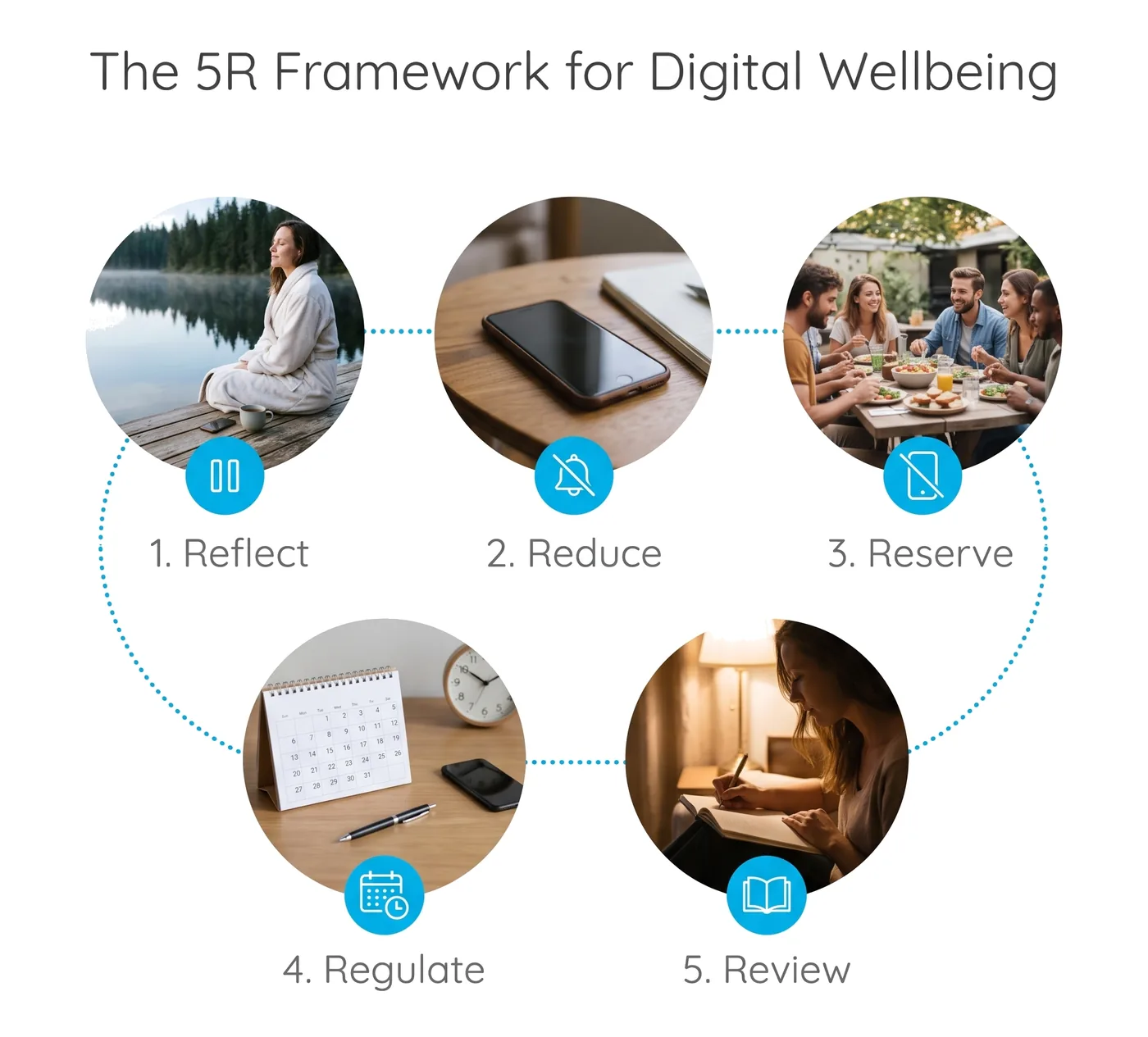
| The 5R Framework for Digital Wellbeing | |
|---|---|
| 1Reflect before you unlock | Many smartphone interactions occur automatically rather than intentionally. Before unlocking your device, pause for just a few seconds and ask yourself: “Why am I picking up my smartphone right now?” If you have a clear purpose (for example, replying to a message, checking directions, making a call), go ahead. If the answer is simply “I don’t know” or “just because,” consider putting the phone back down. This brief pause interrupts habitual behaviour and helps restore conscious decision-making. |
| 2Reduce digital distractions | Our environment strongly influences our behaviour. Smartphones are deliberately designed to compete for our attention, but we can redesign that environment. Simple changes can make a remarkable difference:
The less your smartphone asks for your attention, the easier it becomes to decide when to give it your attention. |
| 3Reserve smartphone-free moments | Not every moment needs to be shared with a screen. Identify one or two situations each day in which your smartphone remains completely absent. For example:
These moments allow your attention to reconnect with the present rather than constantly shifting toward digital stimuli. |
| 4Regulate your digital routines | Many people check their smartphones dozens (or even hundreds) of times each day without any specific reason. Instead of responding immediately to every notification or impulse, try scheduling specific moments to check your smartphone. For example:
This simple change transforms smartphone use from a reactive behaviour into a deliberate choice. |
| 5Review your day | Digital wellbeing is built through awareness. Before going to bed, take a moment to reflect: “Today, did I use my smartphone to support my life, or did my smartphone decide how I spent my attention?” There is no need to judge yourself. Simply becoming aware of your digital habits is often the first step toward changing them. |
Remember that digital wellbeing is a journey rather than a destination. If you feel that your smartphone use has become difficult to control and is negatively affecting important areas of your life, do not hesitate to seek professional support. Mental health professionals can help you better understand your relationship with technology, identify the factors that maintain problematic patterns of use, and develop personalized strategies to regain control. Just as we seek professional guidance for other aspects of our physical and mental health, asking for help with our digital habits is another way of investing in our overall wellbeing.