

While there is no universally accepted definition of meditation, more traditional uses of the word refer to it as a spontaneous state of communion with the inner self that is impossible to define in concrete terms (also known as dhyana or samadhi) (Satyananda 1980; Satyananda 1981). Meditation practices are used to help induce this state.
In more contemporary conceptualizations, “meditation” also refers both to (a) a family of attentional and emotional self-regulation practices aimed at cultivating mental clarity, emotional balance, and well-being and (b) the resultant mental states those practices seek to evoke (Lutz et al., 2008; Tang et al., 2015). Under this umbrella fall mindfulness practices, mantra repetition, loving-kindness/compassion exercises, body-scan techniques, and movement-based forms such as yoga, tai chi, and qigong (Ospina et al., 2007). From this perspective, the scientific literature examines both training mechanisms (e.g., attention regulation, metacognitive monitoring, emotion regulation) and the state-level outcomes that follow from sustained practice.
Historically rooted in contemplative traditions such as Buddhism, Hinduism, Taoism and almost all major religions, meditation has, in recent decades, been adapted into secular contexts, where it is increasingly employed as a therapeutic and preventive health intervention (Walsh & Shapiro, 2006). Contemporary frameworks emphasize its role as a set of self-regulatory techniques involving sustained attention, metacognitive monitoring, and emotion regulation, which together foster psychological resilience and enhance well-being (Sedlmeier et al., 2012).
Meditation techniques are often classified according to their attentional focus. A widely cited framework distinguishes focused attention (FA) and open monitoring (OM) (Lutz et al., 2008). FA involves sustaining attention on a specific object (e.g., the breath, a mantra, or a visual stimulus) while monitoring and minimizing distractions. OM emphasizes a non-reactive awareness of ongoing experience (including thoughts, sensations, and emotions) without attachment or judgment.
Additional typologies have been proposed. Classical sources distinguish passive techniques (typically seated, minimal movement) from active techniques that can be practiced during movement or daily activities (Satyananda, 1974). Automatic self-transcending has been described as involving minimal explicit cognitive control, differing phenomenologically from both FA and OM (Travis & Shear, 2010). Loving-kindness and compassion practices aim to cultivate prosocial emotions toward self and others (Hofmann et al., 2011). Other widely used approaches include movement-based practices (e.g., yoga, tai chi) (Ospina et al., 2007) and the body scan, which sequentially directs attention to bodily regions to enhance interoceptive awareness (Kabat-Zinn, 2013).
Across methods, meta-analyses associate meditation with improvements in psychological well-being, reduced stress and anxiety, and enhancements in aspects of cognition; however, effects vary by technique, practitioner experience, and delivery context (Goyal et al., 2014; Khoury et al., 2013). This heterogeneity underscores the value of matching techniques to learner needs and settings.
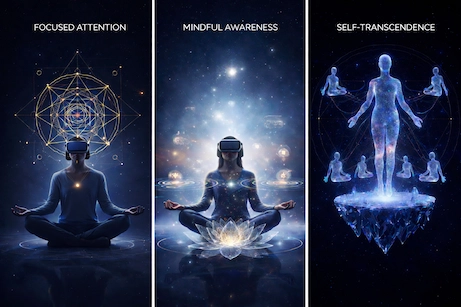
Conceptually, meditation practices can be organized along a continuum of complexity that can reflect increasing demands on attentional control, metacognitive monitoring, and cognitive–motor integration:
However, while these categories are useful, the principal distinction between novices and advanced practitioners is often depth rather than the technique employed. By depth we refer to the strength, continuity, and generalization of the same underlying skills over time. Thus, breath awareness practiced for 5–10 minutes is typically recommended for beginners, whereas continuous breath awareness sustained across many hours (e.g., retreat conditions) constitutes advanced practice. The technique label is unchanged, but the required stability of attention, non-reactivity, and metacognitive monitoring is markedly higher.
Importantly, several attentional practices that serve as beginner foundations can also function as advanced pathways: in many traditions, intensifying the duration and fidelity of simple attentional anchors (e.g., breath, mantra) is precisely how practitioners aim to cultivate some of the deepest meditative states. This two-axis view (technique class x depth), better captures progression: learners may remain within one technique class while advancing primarily through greater depth, and interventions (e.g., VR-delivered formats) can be tailored to scaffold depth-appropriate demands.
Historically, innumerable techniques and methods have been devised to help people achieve the state of meditation (or dhyana).
Satyananda (1980) says that “when machines and synthetic products of our society are used with meditation and spiritual life they become mechanical aids to higher consciousness. In this perspective they can be used on the inner voyage to help establish the process, to aid in the breaking down of our old concepts and conditioning.”
He warns however, “they must always remain in the context of the meditative disciplines if they are not to degenerate. Only meditation can offer a slow but safe and sure path inward, one free from the potential hazards of the sudden release of excessive subconscious and unconscious forces.”
Despite robust evidence for the benefits of meditation, many individuals, particularly novices, struggle to engage with traditional practices due to difficulties sustaining attention, discomfort with stillness, and the abstract nature of introspective exercises (Anderson et al., 2019). Most people are also habituated to an extroverted frame of mind and their perceptions have been dulled by repeated gross sensory input (Satyananda 1980). Such barriers can reduce adherence,blunt the therapeutic potential of conventional methods and create obstacles in achieving deeper meditative states.
In this context, Virtual Reality Meditation (VRM), defined as the delivery of meditative content within immersive virtual environments, has emerged as a promising alternative. By leveraging multisensory simulation and a strong sense of presence, nowadays VRM can provide salient attentional anchors, reduce extraneous cognitive load, and facilitate emotional absorption during practice (Navarro-Haro et al., 2017; Seabrook et al., 2020). In addition, VR affords standardized delivery and environmental control, helping to minimize external distractors that commonly disrupt early meditation training, including ambient noise, interpersonal interruptions, and technology/social-media–related distractions. As the ecosystem evolves (e.g., adaptive content or expanded olfactory/haptic interfaces), future studies and applications may reveal additional benefits of VRM that extend beyond current evidence.
An emerging empirical literature, including randomized controlled trials, pilot studies, and systematic reviews, suggests that VRM can reduce anxiety, enhance attentional control, and increase positive affect, even after brief sessions and among meditation-naïve individuals (Chandrasiri et al., 2020; Tarrant et al., 2018). VR platforms may also be particularly well suited for populations such as university students, veterans/military personnel, and individuals with high trait anxiety, offering aesthetically pleasing, structured environments that do not require extensive prior experience with contemplative practices.
Presence, the subjective sense of “being there” in a virtual environment, is a core mechanism underlying VR’s psychological effects (Alsina-Jurnet et al., 2011). In VRM, presence is amplified by multisensory stimulation (e.g., visual stimuli, spatialized audio, and, in some projects, olfactory or haptic cues), which creates richly embodied scenes that capture and sustain attention. Because attentional stability is foundational to focused attention meditative practices yet easily disrupted by distraction and mental fatigue, especially in novices, these multisensory immersive cues provide salient attentional anchors that support sustained engagement (Lutz et al., 2008).
Notably, VR can invite a re-examination of common assumptions about meditation (particularly the idea that practice must occur with eyes closed). While many traditional meditation techniques emphasize internal focus by closing the eyes, VR-based practices typically involve open-eyed engagement with the immersive environment. This may benefit users by stabilizing attention through visual anchoring, especially for those who find internal eyes-closed introspection overwhelming or distracting. In this context, VR may be especially well suited for active meditations, which involve movement, interaction, or guided attentional shifts, though passive meditations (e.g., breath-focused) are also commonly adapted to immersive formats.
While future research may help clarify how visual involvement in VR mediates attentional, emotional, and contemplative outcomes compared to traditional eyes-closed approaches, research studies report better outcomes with VRM compared with less immersive formats, including video-based meditation (Gentile & Kim, 2024; Kaplan-Rakowski et al., 2021), traditional concentration meditation or control conditions (Kim et al., 2024), audio-guided meditation (Gentile & Kim, 2024; Tarrant et al., 2022), and imagery-based practice (Jo et al., 2024; Perhakaran et al., 2016).
User engagement is a critical determinant of adherence and therapeutic efficacy in psychological interventions. Traditional meditation programs, particularly in self-guided formats, often exhibit high dropout and low adherence, driven by perceived difficulty, boredom, and limited immediate reinforcement (Crane et al., 2014). VRM addresses these barriers by providing immersive, aesthetically appealing, and interactive environments that increase intrinsic motivation to practice.
In a home-practice follow-up, participants assigned to an embodied-VR condition meditated approximately twice as long as those who used standard audio-guided meditation (Navarrete et al., 2021). Additionally, a pioneering study by Cebolla et al. (2019) demonstrated that compassion-based meditation combined with embodied VR significantly increased the frequency of clinical self-care behaviors compared to a control group using traditional, non-embodied meditation. These findings point to the potential of embodied VR to enhance user engagement and intrinsic motivation, key factors in sustaining long-term meditation habits. Complementary studies report higher ratings of interest and enjoyment during VR-delivered meditation compared with video or audio formats, suggesting a motivational advantage that may translate into greater practice dose (Gentile & Kim, 2024).
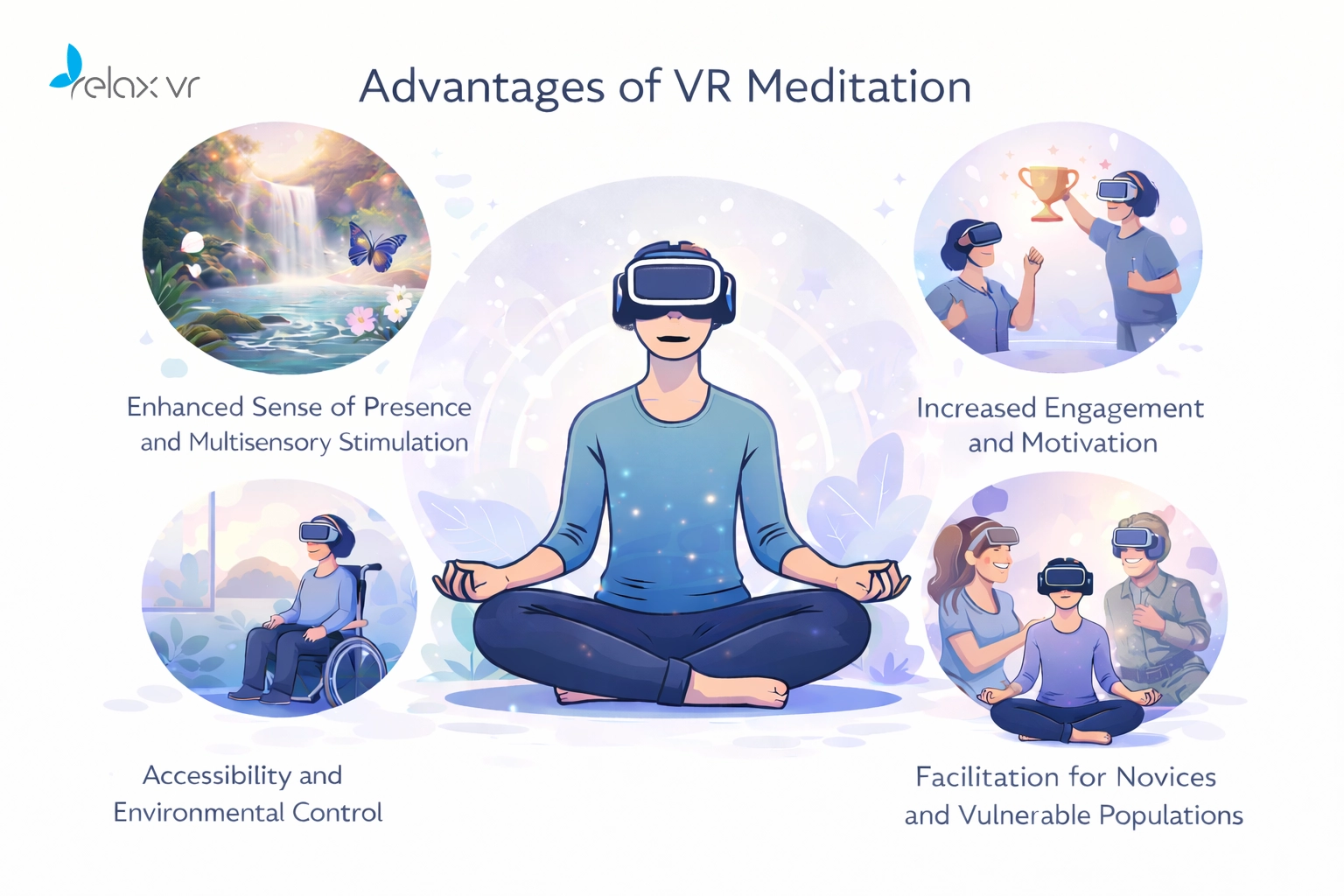
A persistent practical challenge for traditional seated focused attention meditation practices for beginners is securing a quiet, uninterrupted space conducive to practice. Environmental noise, interpersonal interruptions, and ambient discomfort can disrupt meditative focus, particularly in institutional or high-stress settings. VRM helps circumvent these barriers by delivering a standardized, multisensory environment that is largely independent of the external context.
This capacity for environmental standardization is advantageous in clinical workflows, where uniform delivery supports treatment fidelity and reproducibility. Moreover, VR enables meditation practices in settings where traditional contemplative environments are often unavailable, such as hospitals or military deployments (Riches & Williams, 2025; Vianez et al., 2025). For example, among intensive care unit patients, VRM has been associated with improved sleep quality (Lee & Kang, 2020). In healthcare workers, studies report benefits relative to concentration meditation or control conditions, including better subjective sleep, reduced wake after sleep onset, higher sleep efficiency, improved deep sleep, lower subjective and objective stress, and more balanced autonomic indices (Kim et al., 2024; Tarrant et al., 2022).
For individuals unfamiliar with meditation, the introspective nature of traditional practice can be intimidating or cognitively overwhelming. VRM applications, such as Relax VR, offer scaffolded support by externally guiding attention and reducing the metacognitive burden often associated with meditation training. This is particularly relevant for people with high anxiety, trauma-related symptoms, or cognitive difficulties, for whom inward-directed focus may initially provoke discomfort or rumination (Baer, 2003).
Consistent with this rationale, VRM has been explored across a range of populations and clinical/non-clinical contexts, with promising outcomes reported in: homelessness (Chaves et al., 2020); veterans (Liu et al., 2023); older adults (Sadowski et al., 2025) and older adults with knee osteoarthritis (Sarkar et al., 2022); individuals with depression and/or anxiety (Lee et al., 2024; Ma et al., 2025); rheumatoid arthritis–related fatigue (Dreesmann et al., 2023); patients with opioid tolerance or opioid use disorders, where VR-guided meditation has been associated with statistically significant reductions in patient-reported pain (Hargett et al., 2022); cancer-related anxiety, stress, and fatigue (Franklin et al., 2023) and students with test anxiety, where VR meditation outperformed video-based meditation (Kaplan-Rakowski et al., 2021).
Most VRM studies enroll VR-naïve, meditation-naïve participants and implement brief, low-complexity practices (e.g., relaxation, breath-focused, or guided mindfulness), typically delivered in single or few sessions. Across randomized trials and pilot studies, VRM shows superior outcomes in comparison to less immersive comparators (e.g., video, audio, imagery, or waitlist/control). Those studies support the feasibility and short-term benefits under these novice-oriented conditions.
Taken together, current evidence supports positioning VRM as an entry-and-progression tool for lower-complexity meditation skills, particularly for novice meditators, who appear to benefit from VR’s presence-driven attentional anchoring, environmental control, and motivational pull (Jo et al. 2024).
By contrast, the efficacy of VRM for experienced meditators engaging in higher-complexity, metacognitive practices (e.g., open monitoring, compassion) remains under-studied. The clearest expert-sample report is a pilot study in which mindfulness experts completed a VR-assisted Dialectical Behavior Therapy (DBT) mindfulness exercise. The participants rated VR mindfulness as acceptable/feasible and showed increased state mindfulness and reduced negative affect after a single session; however, there was no control group and only immediate outcomes were assessed (Navarro-Haro et al., 2017). Complementing this study, a comparative research study found that VR advantages were stronger for novices than for experienced meditators, suggesting that the incremental benefit of immersion may diminish as expertise increases (Jo et al., 2024).
Emerging work suggests that immersive VR can support meditation by reliably eliciting awe and self-transcendent experiences (STEs), providing experiential access to sacred places and rituals for instructional purposes, and enabling symbolic/visual practices (e.g., mandalas, sacred geometry) in interactive form.
Despite these promising early findings, more rigorously designed and adequately powered studies are required to assess whether VR-evoked transcendental experiences lead to lasting contemplative skills or enhanced educational outcomes.
Meditation reliably improves psychological well-being, emotion regulation, and stress outcomes, yet practical barriers can constrain its impact. VRM can mitigate some of these constraints by leveraging multisensorial experiences to stabilize attention, heighten motivation, and standardize delivery across settings.
Current studies suggest that the most consistent benefits occur for novice practitioners and lower-complexity techniques (e.g., relaxation). In these conditions, VRM outperforms video, audio, or imagery techniques on short-term outcomes and adherence. Accordingly, VRM can be best positioned as an entry-and-progression tool that lowers barriers to initial practice and supports stepwise skill development. By contrast, evidence for experienced meditators and higher-complexity meditation practices remains limited.
Overall, VRM can complement, rather than replace, traditional approaches: it lowers entry barriers and accelerates early learning, while its role in advanced practice is a promising target for rigorous evaluation.
Alsina-Jurnet, I., Gutiérrez-Maldonado, J., & Rangel-Gómez, M.-V. (2011). The role of presence in the level of anxiety experienced in clinical virtual environments. Computers in Human Behavior, 27(1), 504–512. https://doi.org/10.1016/j.chb.2010.09.018
Ameta, D., Garg, A., Kumar, P., Behera, L., & Dutt, V. (2023). Evaluating the effectiveness of mantra meditation in a 360° virtual reality environment. In Proceedings of the 16th International Conference on PErvasive Technologies Related to Assistive Environments (PETRA ’23) (pp. 766–772). Association for Computing Machinery. https://doi.org/10.1145/3594806.3596587
Anderson, T., Suresh, M., & Farb, N. A. (2019). Meditation benefits and drawbacks: Empirical codebook and implications for teaching. Journal of Cognitive Enhancement, 3, 207–220. https://doi.org/10.1007/s41465-018-00119-y
Baer, R. A. (2003). Mindfulness training as a clinical intervention: A conceptual and empirical review. Clinical Psychology: Science and Practice, 10(2), 125–143. https://doi.org/10.1093/clipsy.bpg015
Cahn, B. R., & Polich, J. (2006). Meditation states and traits: EEG, ERP, and neuroimaging studies. Psychological Bulletin, 132(2), 180–211. https://doi.org/10.1037/0033-2909.132.2.180
Cebolla, A., Herrero, R., Ventura, S., Miragall, M., Bellosta-Batalla, M., Llorens, R., & Baños, R.M. (2019). Putting oneself in the body of others: a pilot study on the efficacy of an embodied virtual reality system to generate self-compassion. Frontiers in Psychology, 10:1521. DOI: https://doi.org/10.3389/fpsyg.2019.01521
Chandrasiri, A., Collett, J., Fassbender, E., & de Foe, A. (2020). A virtual reality approach to mindfulness skills training. Virtual Reality, 24, 143–149. https://doi.org/10.1007/s10055-019-00380-2
Chavez, L. J., Kelleher, K., Slesnick, N., Holowacz, E., Luthy, E., Moore, L., & Ford, J. (2020). Virtual Reality Meditation Among Youth Experiencing Homelessness: Pilot Randomized Controlled Trial of Feasibility. JMIR Mental Health, 7(9), e18244. https://doi.org/10.2196/18244
Crane, C., Crane, R. S., Eames, C., Fennell, M. J., Silverton, S., Williams, J. M., & Barnhofer, T. (2014). The effects of amount of home meditation practice in Mindfulness Based Cognitive Therapy on hazard of relapse to depression in the Staying Well after Depression Trial. Behaviour Research and Therapy, 63, 17–24. https://doi.org/10.1016/j.brat.2014.08.015
Dahl, C. J., Lutz, A., & Davidson, R. J. (2015). Reconstructing and deconstructing the self: cognitive mechanisms in meditation practice. Trends in Cognitive Sciences, 19(9), 515–523. https://doi.org/10.1016/j.tics.2015.07.001
Dreesmann, N. J., Buchanan, D., Tang, H. J., Furness Iii, T., & Thompson, H. (2023). Virtual Reality Meditation for Fatigue in Persons With Rheumatoid Arthritis: Mixed Methods Pilot Study. JMIR Formative Research, 7, e46209. https://doi.org/10.2196/46209
Fikria, A., & Rafsanjanie, F. H. (2025). Exploring Virtual Reality in Pre-Hajj Training to Deepen Pilgrims’ Sense of Spiritual Understanding. Munazzama: Journal of Islamic Management and Pilgrimage, 5(1), 21–37. https://doi.org/10.21580/mz.v5i1.25150
Franklin, D. M., Silvestro, C., Carrillo, R. A., Yang, Y., Annadurai, D., Ganesan, S., Vasantham, D. S. J., Mettu, S., Patel, M., Patil, M. S., & Akurathi, N. D. (2023). The impact of meditation aided by VR technology as an emerging therapeutic to ease cancer-related anxiety, stress, and fatigue. Frontiers in Virtual Reality, 4, 1195196. https://doi.org/10.3389/frvir.2023.1195196
Gard, T., Noggle, J. J., Park, C. L., Vago, D. R., & Wilson, A. (2014). Potential self-regulatory mechanisms of yoga for psychological health. Frontiers in Human Neuroscience, 8, 770. https://doi.org/10.3389/fnhum.2014.00770
Gentile, D. A., & Kim, E.-L. (2024). Comparing virtual reality, video, and audio-guided meditations in fostering positive attitudes toward meditation. Mindfulness, 15(3), 586–600. https://doi.org/10.1007/s12671-024-02311-y
Glowacki, D. R., Williams, R. R., Wonnacott, M. D., et al. (2022). Group VR experiences can produce ego attenuation and connectedness comparable to psychedelics. Scientific Reports, 12, 8995. https://doi.org/10.1038/s41598-022-12637-z
Goyal, M., Singh, S., Sibinga, E. M., Gould, N. F., Rowland-Seymour, A., Sharma, R., Berger, Z., Sleicher, D., Maron, D. D., Shihab, H. M., Ranasinghe, P. D., Linn, S., Saha, S., Bass, E. B., &
Hargett, J. L., McElwain, S. D., McNair, M. E., Palokas, M. J., Martin, B. S., & Adcock, D. L. (2022). Virtual Reality Based Guided Meditation for Patients with Opioid Tolerance and Opioid Use Disorders. Pain Management Nursing: Official Journal of the American Society of Pain Management Nurses, 23(3), 259–264. https://doi.org/10.1016/j.pmn.2022.02.005
Haythornthwaite, J. A. (2014). Meditation programs for psychological stress and well-being: a systematic review and meta-analysis. JAMA Internal Medicine, 174(3), 357–368. https://doi.org/10.1001/jamainternmed.2013.13018
Hofmann, S. G., Grossman, P., & Hinton, D. E. (2011). Loving-kindness and compassion meditation: potential for psychological interventions. Clinical Psychology Review, 31(7), 1126–1132. https://doi.org/10.1016/j.cpr.2011.07.003
Jo, M., Kim, E., & Lee, J. (2024). Virtual reality vs. imagery: comparing approaches in guided meditation. Frontiers in Psychology, 15, 1472780. https://doi.org/10.3389/fpsyg.2024.1472780
Kabat-Zinn, J. (2013). Full catastrophe living, revised edition: How to cope with stress, pain and illness using mindfulness meditation (2nd ed.). Piatkus. Available at: https://www.amazon.com/Full-Catastrophe-Living-Revised-Illness/dp/0345536932
Kaplan-Rakowski, R., Johnson, K. R., & Wojdynski, T. (2021). The impact of virtual reality meditation on college students' exam performance. Smart Learning Environments, 8(1), 21. https://doi.org/10.1186/s40561-021-00166-7
Khoury, B., Lecomte, T., Fortin, G., Masse, M., Therien, P., Bouchard, V., Chapleau, M. A., Paquin, K., & Hofmann, S. G. (2013). Mindfulness-based therapy: a comprehensive meta-analysis. Clinical Psychology Review, 33(6), 763–771. https://doi.org/10.1016/j.cpr.2013.05.005
Kim, K. Y., Hur, M. H., & Kim, W. J. (2024). Effects of Virtual Reality (VR)-Based Meditation on Sleep Quality, Stress, and Autonomic Nervous System Balance in Nursing Students. Healthcare (Basel, Switzerland), 12(16), 1581. https://doi.org/10.3390/healthcare12161581
Lee, S. Y., & Kang, J. (2020). Effect of virtual reality meditation on sleep quality of intensive care unit patients: A randomised controlled trial. Intensive & Critical Care Nursing, 59, 102849. https://doi.org/10.1016/j.iccn.2020.102849
Lee, J., Kim, J., & Ory, M. G. (2024). The impact of immersive virtual reality meditation for depression and anxiety among inpatients with major depressive and generalized anxiety disorders. Frontiers in Psychology, 15, 1471269. https://doi.org/10.3389/fpsyg.2024.1471269
Liu, K., Madrigal, E., Chung, J. S., Parekh, M., Kalahar, C. S., Nguyen, D., Timmerman, M., & Harris, O. A. (2023). Preliminary Study of Virtual-reality-guided Meditation for Veterans with Stress and Chronic Pain. Alternative Therapies in Health and Medicine, 29(6), 42–49. Available at: http://www.alternative-therapies.com/pdfarticles/68611.pdf
Lutz, A., Slagter, H. A., Dunne, J. D., & Davidson, R. J. (2008). Attention regulation and monitoring in meditation. Trends in Cognitive Sciences, 12(4), 163–169. https://doi.org/10.1016/j.tics.2008.01.005
Ma, J., Li, H., Liang, C., et al. (2025). A brief virtual reality-based mindfulness intervention can improve olfactory perception while reducing depression and anxiety symptoms in university students. Humanities and Social Sciences Communications, 12, 294. https://doi.org/10.1057/s41599-025-04584-7
Navarrete, J., Martínez-Sanchis, M., Bellosta-Batalla, M., Baños, R., Cebolla, A., & Herrero, R. (2021). Compassionate Embodied Virtual Experience Increases the Adherence to Meditation Practice. Applied Sciences, 11(3), 1276. https://doi.org/10.3390/app11031276
Navarro-Haro, M. V., López-Del-Hoyo, Y., Campos, D., Linehan, M. M., Hoffman, H. G., García-Palacios, A., Modrego-Alarcón, M., Borao, L., & García-Campayo, J. (2017). Meditation experts try Virtual Reality Mindfulness: A pilot study evaluation of the feasibility and acceptability of Virtual Reality to facilitate mindfulness practice in people attending a Mindfulness conference. PloS One, 12(11), e0187777. https://doi.org/10.1371/journal.pone.0187777
Ospina, M. B., Bond, K., Karkhaneh, M., Tjosvold, L., Vandermeer, B., Liang, Y., Bialy, L., Hooton, N., Buscemi, N., Dryden, D. M., & Klassen, T. P. (2007). Meditation practices for health: state of the research. Evidence Report/Technology Assessment, (155), 1–263. Available at: https://pmc.ncbi.nlm.nih.gov/articles/PMC4780968/
Perhakaran, G., Yusof, A. M., Rusli, M. E., Yusoff, M. Z. M., Mahalil, I., & Zainuddin, A. R. R. (2016). A study of meditation effectiveness for virtual reality-based stress therapy using EEG measurement and questionnaire approaches. In Y. W. Chen, C. Torro, S. Tanaka, R. Howlett, & L. C. Jain (Eds.), Innovation in Medicine and Healthcare 2015 (Vol. 45, pp. 367–378). Springer. https://doi.org/10.1007/978-3-319-23024-5_33
Riches, S., & Williams, G. (2025). Virtual reality relaxation for hospitals: A novel stress-reduction intervention for patients, families, and staff. Future Healthcare Journal, 12(2), 100234. https://doi.org/10.1016/j.fhj.2025.100234
Sadowski, I., Meilleur-Bédard, M., & Khoury, B. (2025). A Novel Virtual Reality-Based Nature Meditation Program for Older Adults' Mental Health: Results from a Pilot Randomized Controlled Trial. Clinical Gerontologist, 48(4), 663–683. https://doi.org/10.1080/07317115.2025.2482089
Sarkar, T. D., Edwards, R. R., & Baker, N. (2022). The feasibility and effectiveness of virtual reality meditation on reducing chronic pain for older adults with knee osteoarthritis. Pain Practice: The Official Journal of World Institute of Pain, 22(7), 631–641. https://doi.org/10.1111/papr.13144
Satyananda, S. (1974). Meditations from the Tantras. Munger: Yoga Publications Trust. Available at: https://archive.org/download/folder-20230407-20/Meditations%20from%20the%20Tantras.pdf
Satyananda, S. (1980). Sure Ways to self realisation. Munger: Yoga Publications Trust. Available at: https://www.abebooks.com/9788185787411/Sure-Ways-Realisation-Saraswati-Swami-8185787417/plp
Satyananda, S. (1981). A systematic course in the ancient tantric techniques of Yoga and Kriya. Munger: Yoga Publications Trust. Available at: https://archive.org/details/systematiccourse0000saty
Scott, J. A., Sims, M., Harrold, L., Jacobus, N., Avelar, C., & Durham, J. (2022). Transformation of Buddhist mandalas into a virtual reality installation. Leonardo, 55(3), 219–224. https://doi.org/10.1162/leon_a_02145
Seabrook, E., Kelly, R., Foley, F., Theiler, S., Thomas, N., Wadley, G., & Nedeljkovic, M. (2020). Understanding How Virtual Reality Can Support Mindfulness Practice: Mixed Methods Study. Journal of Medical Internet Research, 22(3), e16106. https://doi.org/10.2196/16106
Sedlmeier, P., Eberth, J., Schwarz, M., Zimmermann, D., Haarig, F., Jaeger, S., & Kunze, S. (2012). The psychological effects of meditation: A meta-analysis. Psychological Bulletin, 138(6), 1139–1171. https://doi.org/10.1037/a0028168
Tang, Y.-Y., Hölzel, B. K., & Posner, M. I. (2015). The neuroscience of mindfulness meditation. Nature Reviews Neuroscience, 16(4), 213–225. https://doi.org/10.1038/nrn3916
Tarrant, J., Viczko, J., & Cope, H. (2018). Virtual Reality for Anxiety Reduction Demonstrated by Quantitative EEG: A Pilot Study. Frontiers in Psychology, 9, 1280. https://doi.org/10.3389/fpsyg.2018.01280
Tarrant, J., Jackson, R., & Viczko, J. (2022). A feasibility test of a brief mobile virtual reality meditation for frontline healthcare workers in a hospital setting. Frontiers in Virtual Reality, 3, 764745. https://doi.org/10.3389/frvir.2022.764745
Travis, F., & Shear, J. (2010). Focused attention, open monitoring and automatic self-transcending: Categories to organize meditations from Vedic, Buddhist and Chinese traditions. Consciousness and Cognition, 19(4), 1110–1118. https://doi.org/10.1016/j.concog.2010.01.007
Vianez, A., Marques, A., Loureiro, J., & Veloso Gomes, P. (2025). Military stress management training using virtual reality: A systematic review and Delphi method. Computers in Human Behavior Reports, 19, 100734. https://doi.org/10.1016/j.chbr.2025.100734
Walsh, R., & Shapiro, S. L. (2006). The meeting of meditative disciplines and western psychology: A mutually enriching dialogue. American Psychologist, 61(3), 227–239. https://doi.org/10.1037/0003-066X.61.3.227
Zeidan, F., Johnson, S. K., Diamond, B. J., David, Z., & Goolkasian, P. (2010). Mindfulness meditation improves cognition: Evidence of brief mental training. Consciousness and Cognition, 19(2), 597–605. https://doi.org/10.1016/j.concog.2010.03.014